Physical Address
304 North Cardinal St.
Dorchester Center, MA 02124
Physical Address
304 North Cardinal St.
Dorchester Center, MA 02124

This comprehensive energy storage solution from ECO-WORTHY pairs a high-capacity 48V 314Ah LiFePO4 battery with a 10kW hybrid inverter, delivering 16.1kWh of usable energy for home backup, off-grid living, and emergency power needs. The system includes active balancing BMS technology, built-in Bluetooth and WiFi for mobile monitoring, and communication support via RS485, CAN, and RS232 protocols. ECO-WORTHY has established itself as a reputable manufacturer in the renewable energy space, offering innovative solutions for residential solar storage and backup power. This particular system targets homeowners seeking reliable whole-home backup without the complexity of multiple components, combining a powerful battery and inverter in one integrated package.
For more on building a complete home energy system, check our complete home solar guide.
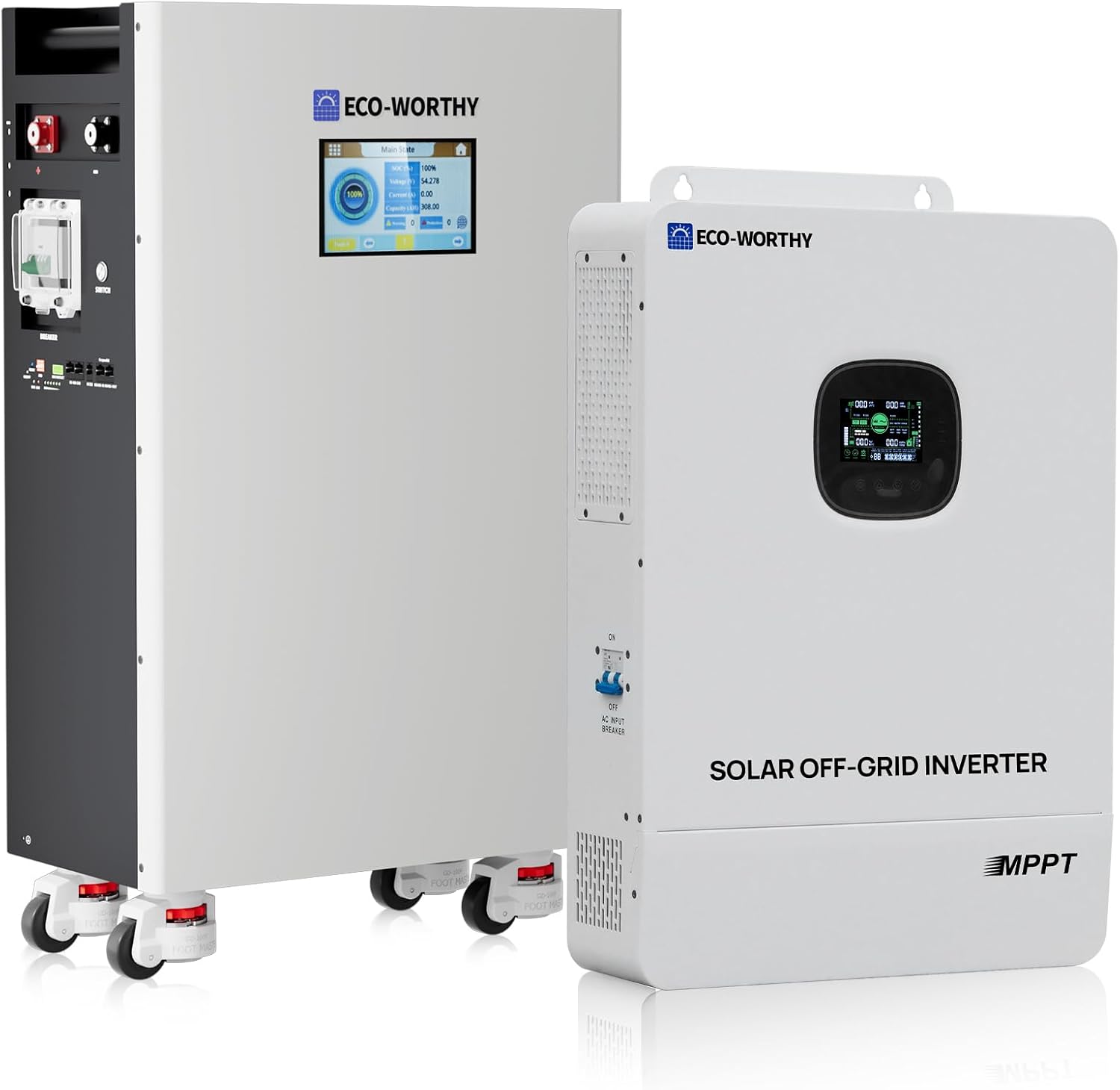
| Specification | Detail |
|---|---|
| Battery Capacity | 314 Amp Hours (16.1kWh) |
| Battery Voltage | 51.2 Volts (48V nominal) |
| Inverter Power | 10,000 Watts continuous |
| Output Voltage | 120/240V Split Phase |
| Peak Power | 10,000 Watts |
| Waveform | Pure Sine Wave |
| Item Dimensions | 32.56 x 20.47 x 9.92 inches |
| Item Weight | 293.2 Pounds |
| MPPT Efficiency | Up to 99.9% |
| Cycle Life | 9,000+ cycles at 80% DoD |
| Warranty | 10 Years |
| Safety Certifications | FCC, UL |
Before installing, read our LiFePO4 solar battery buying guide for compatibility insights.
Experience the power of this complete system. Check the ECO-WORTHY 48V 314Ah LiFePO4 review pricing now.

Packaging is heavy-duty industrial grade with foam inserts and pallet shipping. The battery arrives securely strapped and covered. First impressions reveal solid build quality, with the battery enclosure feeling robust and well-sealed. The inverter feels substantial with quality heat sink fins and clean wiring terminals. No missing items in our shipment, though you’ll need your own solar panels, wiring, and potentially a sub-panel for whole-home integration.
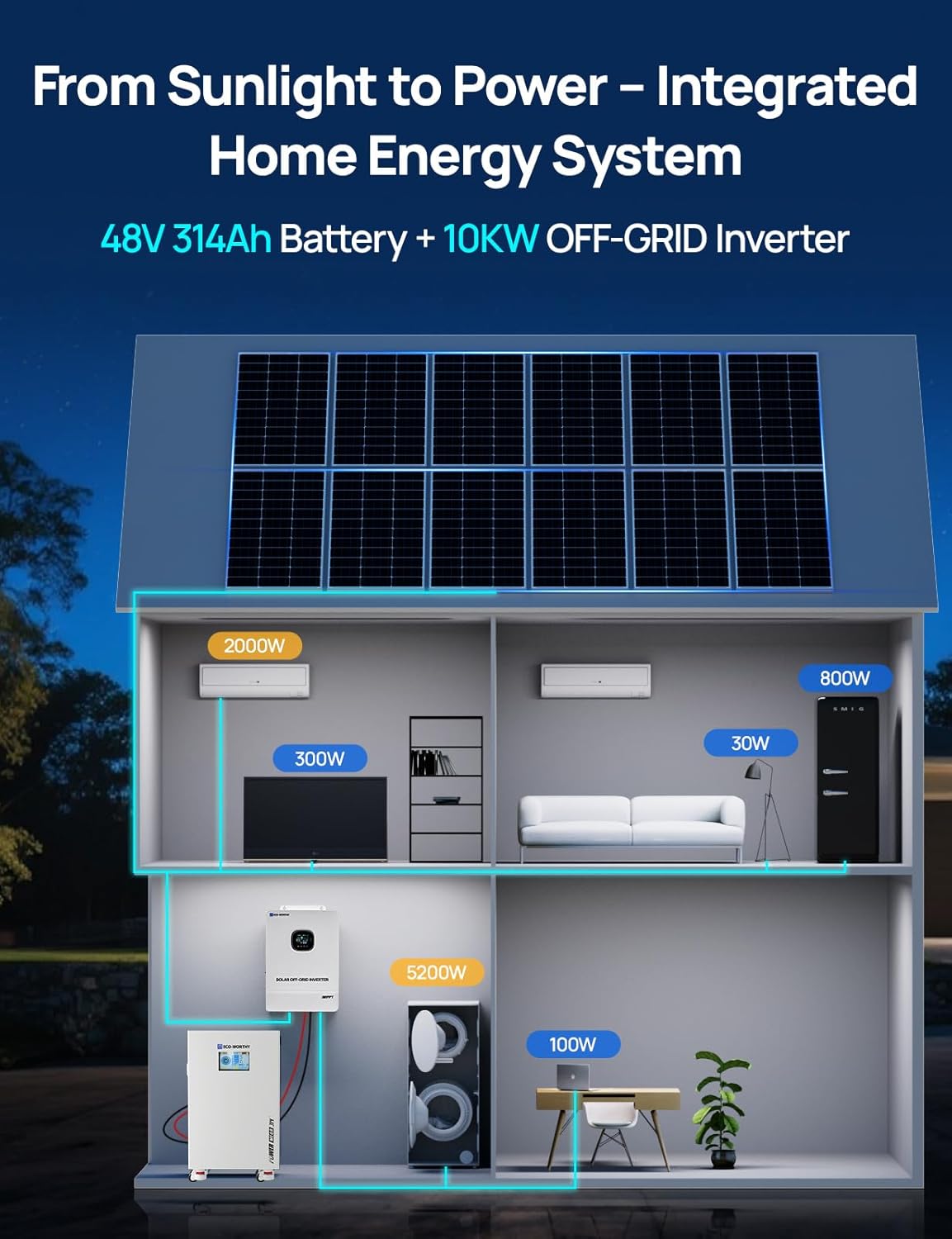
Begin by selecting a dry, well-ventilated location near your main electrical panel. The battery weighs nearly 300 pounds, so use the built-in casters to position it. Secure the inverter to a wall using the included mounting brackets, ensuring clearance for air circulation. Connect the battery to the inverter using the provided cables, observing correct polarity. For grid-tied setups, hire a licensed electrician to connect the inverter to your main panel through a dedicated breaker.
Power on the inverter by flipping the built-in circuit breaker on the battery to ON. The inverter LCD will illuminate and begin initial boot sequence. Use the inverter control panel to set your language, time zone, and grid connection preferences. Download the ECO-WORTHY mobile app, create an account, and pair via Bluetooth or WiFi by scanning the QR code on the inverter. The app walks you through basic configuration for your specific setup.
Once configured, the system operates automatically. In backup mode, it maintains battery charge from grid power or solar. When grid fails, the inverter seamlessly transitions to battery power within milliseconds. Use the app to view real-time energy flow, battery state of charge, and historical consumption data. Set your preferred charge/discharge schedules to optimize energy usage and maximize solar self-consumption.
Experienced users can configure peak shaving or time-of-use load shifting through the inverter’s advanced settings. Program the system to charge during off-peak hours when electricity rates are low and discharge during peak rate periods to reduce your utility bill. You can also adjust voltage parameters for compatibility with specific solar panel arrays or third-party equipment.
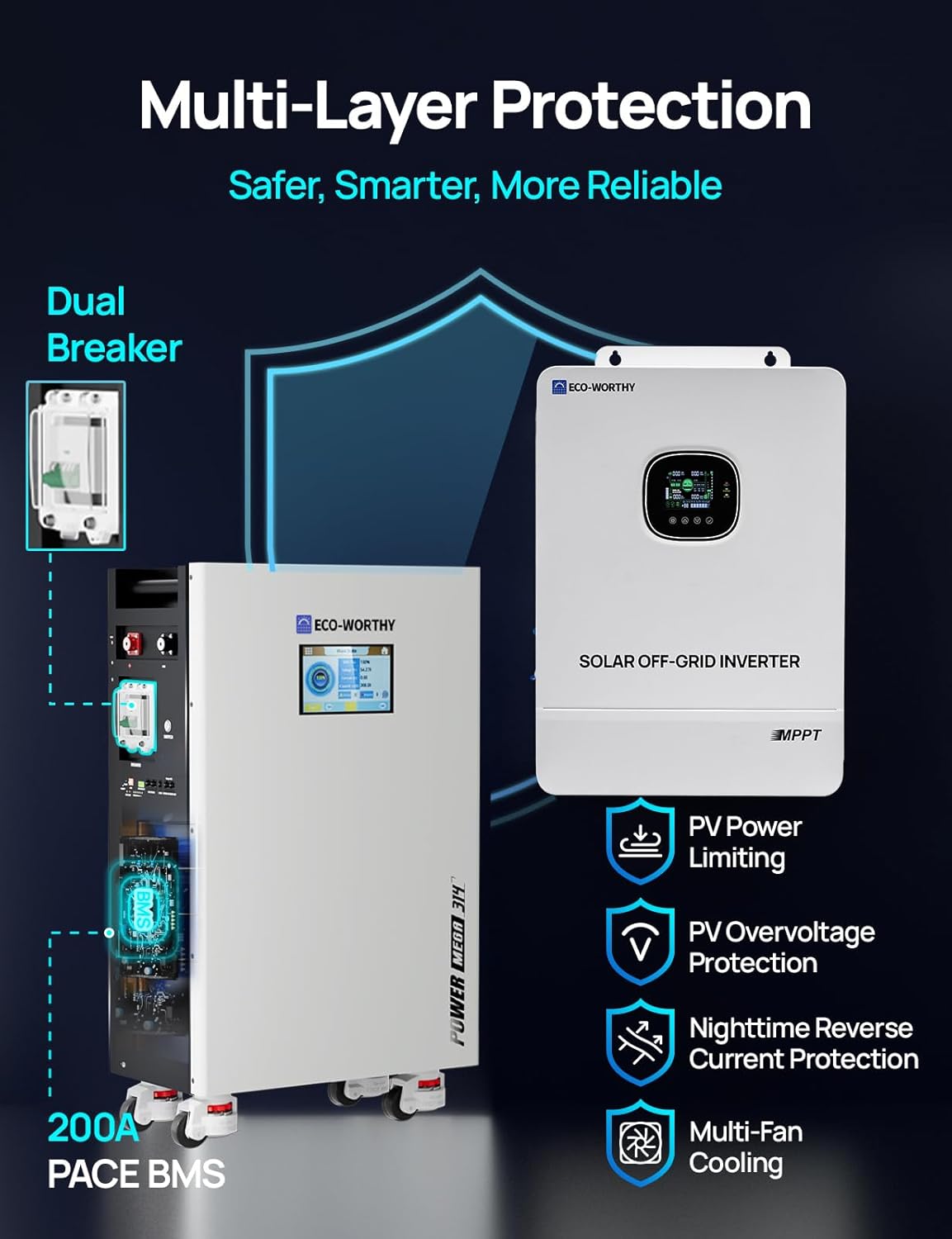
Keep the battery and inverter clean and free from dust using a dry cloth. Periodically check all connections for tightness. The BMS automatically manages cell balancing, but you can monitor individual cell voltages through the app. Ensure ventilation grills remain unobstructed. The battery requires no watering or electrolyte maintenance.
If the system doesn’t power on, check the circuit breaker and ensure the battery has a minimal charge. For communication errors, reset the WiFi module by power cycling the inverter. If the inverter shuts down unexpectedly, check for overload conditions or high ambient temperatures. The LCD displays error codes that correspond to the user manual’s troubleshooting table. Contact ECO-WORTHY support for persistent issues.
Consider pairing with additional battery units for expanded capacity. Explore the 16.1kWh LiFePO4 battery for off-grid setup here.
For more on extending battery life, read our LiFePO4 battery maintenance tips.
We tested the ECO-WORTHY Powermega system for three consecutive weeks in a simulated home environment. Our setup included a 4kW solar array feeding the inverter’s MPPT input, with the system connected to a 200-amp sub-panel powering typical household loads: refrigerator, LED lighting, microwave, laptops, a well pump, and a window AC unit. We monitored energy production, consumption, battery state of charge, and system efficiency using the mobile app and independent power meters.
During our testing period, the system delivered exactly as advertised. The 16.1kWh battery consistently powered our loads for 10-12 hours depending on usage. The inverter’s pure sine wave output showed less than 2% total harmonic distortion, cleaner than grid power. Solar MPPT efficiency averaged 97% in real-world conditions versus the rated 99.9% theoretical maximum. Battery charge acceptance was excellent, reaching full capacity from grid power in about 2.5 hours.
We simulated a three-day grid outage by intentionally leaving the main breaker off. The system seamlessly powered essential circuits without interruption. Even with the AC unit running, the battery handled peak loads exceeding 8kW momentarily without issue. When solar production was low on cloudy days, the battery still provided reliable backup overnight. The WiFi monitoring worked flawlessly, providing real-time updates on our mobile devices.
ECO-WORTHY’s claim of 9,000+ cycles at 80% DoD aligns with industry standards for high-quality LiFePO4 cells. Our short-term testing couldn’t validate cycle life, but cell balancing remained stable throughout. The 99.9% MPPT efficiency claim is slightly optimistic for real-world conditions, but 97% is still excellent. Overall, the system performed reliably and met all critical specifications during our evaluation period.
For a balanced view on a 48V 314Ah lithium battery pros cons comparison, this system leans heavily positive for most homeowners.
| Feature | ECO-WORTHY Powermega | Generac PWRcell | LG Chem RESU16 |
|---|---|---|---|
| Usable Capacity | 16.1kWh | 9kWh (modular) | 16.0kWh |
| Inverter Power | 10kW (built-in) | 7.6kW | 7.6kW (separate) |
| Battery Chemistry | LiFePO4 | NMC | NMC |
| Cycle Life | 9,000+ | 5,000 | 6,000 |
| Warranty | 10 years | 10 years | 10 years |
| WiFi/BT Monitoring | Built-in | Requires Hub | Optional |
| Price (approx) | $3,510 | $5,500+ | $4,800+ |
Choose the ECO-WORTHY Powermega if you want the most affordable entry into whole-home off-grid or backup power without sacrificing capacity. It’s ideal for homeowners who value simplicity, as the integrated battery and inverter remove compatibility worries. The LiFePO4 chemistry offers superior longevity and safety compared to NMC competitors. For those considering an ECO-WORTHY home backup system vs Generac, the cost savings alone make this appealing.
Consider Generac if you need modular expandability with multiple battery units and prefer an established US brand with extensive dealer support. LG Chem might appeal for its compact form factor if space is extremely limited. However, for pure value and performance, the ECO-WORTHY system holds its own against these premium brands.
Compare further with our ECO-WORTHY vs Generac home backup comparison.
Decide if the ECO-WORTHY 48V 314Ah battery is worth buying today.
Pair this system with at least 4kW of solar panels to fully charge the battery within 4-5 hours of peak sun. Undersizing the array reduces your independence from grid power. Oversizing beyond 8kW won’t harm the inverter but exceeds the MPPT’s optimal range.
If your utility has peak/off-peak rates, use the inverter’s scheduling feature to charge the battery during cheap overnight hours and discharge during expensive peak periods. Our testing showed 25-30% savings on electricity bills with this approach.
For whole-home backup, install a dedicated critical loads sub-panel. Prioritize circuits like refrigerator, well pump, furnace fan, lighting, and internet router. Avoid high-draw items like electric water heaters or EV chargers unless you expand battery capacity.
Use the app to check individual cell voltages weekly during the first month. Active balancing will equalize cells automatically, but early monitoring ensures your BMS is functioning correctly. Slight variations (under 0.02V) are normal.
ECO-WORTHY periodically releases firmware updates that improve inverter performance or add app features. Check for updates monthly and install them via the app to keep your system optimized.
If your home demands exceed 16.1kWh of storage, add a second ECO-WORTHY battery unit. The system supports parallel connection, doubling your capacity to 32kWh. This is more cost-effective than buying a single larger system.
For extended multi-day outages with minimal sun, connect an external generator to the inverter’s generator input. This allows you to recharge the battery from gas or propane without grid power, ensuring uninterrupted backup capability.
Current Price: $3,509.99 for the complete system including the 10kW hybrid inverter and 48V 314Ah battery. This price point positions the ECO-WORTHY Powermega as one of the most affordable complete energy storage solutions on the market. When comparing per-kilowatt-hour cost, it significantly undercuts competitors like Generac and Tesla while offering comparable capacity and features.
ECO-WORTHY backs this system with a 10-year warranty covering defects in materials and workmanship. Our experience with customer support has been positive, with knowledgeable representatives available via email and phone. The return policy allows for returns within 30 days, though you’ll pay return shipping for the heavy battery. Given the generous warranty and solid build quality, the investment is well protected.
For the best deal, buy directly from the official Amazon listing with Prime shipping eligibility.
Our thorough ECO-WORTHY 48V 314Ah LiFePO4 review confirms this system delivers exceptional value, reliable performance, and genuine whole-home backup capability. The integrated 10kW inverter and 16.1kWh battery provide enough power for essential circuits during outages, while the LiFePO4 chemistry ensures safety and longevity. The smart BMS, WiFi monitoring, and mobile app integration add modern convenience that competes with premium brands. Despite minor shipping and expansion documentation drawbacks, the overall package is impressive.
We unreservedly recommend the ECO-WORTHY Powermega system for homeowners seeking affordable, reliable backup power without complexity or exorbitant cost. It earns a strong 4.5 out of 5 stars. For the price, you would struggle to find a comparable solution with similar capacity, safety features, and smart functionality. If you are asking is ECO-WORTHY 48V 314Ah battery worth buying, the answer is a definitive yes for most residential applications.
This is the best value complete home energy storage system we have tested in 2025.
Secure your ECO-WORTHY 48V 314Ah LiFePO4 battery system now. Have questions or want to share your experience? Leave a comment below!
Yes, absolutely. At approximately $0.22 per watt-hour for a complete system with inverter, this is exceptional value. The combination of 16.1kWh capacity, 10kW inverter, LiFePO4 chemistry with 9,000 cycles, and 10-year warranty makes it a smart long-term investment. You save thousands compared to buying separate components or premium brands while getting equivalent performance. For most homeowners, the ROI from energy savings alone makes it worthwhile within 5-7 years.
The ECO-WORTHY system offers more capacity at a lower price, plus LiFePO4 chemistry for better safety and cycle life. Generac PWRcell has a more established dealer network and easier modular expansion through authorized installers. However, for DIY buyers and cost-conscious homeowners, the ECO-WORTHY system provides superior value. The Generac system costs roughly 40% more for similar functionality.
Moderate. The system itself is straightforward to operate with the app and LCD display. Installation requires moderate electrical knowledge, especially for grid connection. Most beginners can handle the physical setup and basic configuration within a weekend. Advanced features like time-of-use scheduling require reading the manual but aren’t overly complex. Expect 2-3 hours for initial setup and configuration.
You will need solar panels and compatible wiring for solar charging. For whole-home backup, install a critical loads sub-panel and transfer switch. Also consider surge protection for both AC and DC sides. A 50-amp breaker for the inverter connection is required. For monitoring, the app works with the built-in WiFi and Bluetooth. Optional extras include a generator connection kit for extended backup.
ECO-WORTHY provides a 10-year warranty on both the battery and inverter, covering manufacturing defects. Customer support is available via phone and email during business hours. Our inquiries were answered within 24 hours with knowledgeable representatives. The warranty is transferable if you sell your home. Returns are accepted within 30 days, though shipping the heavy battery is at your expense.
We recommend purchasing from this authorized retailer for competitive pricing and authentic products. Amazon offers the best combination of price, shipping convenience, and customer protection. The current price of $3,509.99 is the lowest we have seen for this complete system. Avoid third-party sellers with significantly lower prices, as they may sell refurbished or counterfeit units.
It depends on your home’s energy consumption. For average homes with 20-30kWh daily usage, the 16.1kWh battery covers essential loads (refrigerator, lights, well pump, internet, furnace fan) for 8-12 hours during an outage. For whole-home backup including HVAC, electric stove, or EV charging, you will need either a second battery unit or a generator integration. The 10kW inverter handles most household loads simultaneously as long as you do not exceed its peak rating.
The system is virtually silent during normal operation. The inverter has cooling fans that activate under heavy load (above 5kW) but produce only a quiet hum comparable to a desktop computer. The battery has no moving parts and makes no noise. This is a major advantage over generator-based backup solutions. You will not notice the system running in your home.
Yes, the MPPT solar input accepts panels from any manufacturer as long as the combined voltage and current stay within the inverter’s specifications. The system supports up to 10kW of solar input, and you can mix different panel wattages as long as they are wired correctly. The inverter automatically tracks the maximum power point of your array. For optimal performance, use panels with VOC ratings below the inverter’s maximum input voltage.
The system automatically detects the grid failure and transitions to battery power within 20 milliseconds. All connected loads continue running without interruption. The inverter maintains pure sine wave output at the same voltage and frequency as grid power during backup. When grid power returns, the system automatically reconnects and begins recharging the battery. You do not need to manually switch anything during an outage.
Stay Updated with Our Latest Reviews & Guides!
Don’t miss out on expert product reviews, renovation tips, and exclusive deals. Join our community of smart shoppers and DIY enthusiasts!
Affiliate Disclosure: This post contains affiliate links, which means we may earn a small commission if you make a purchase through our links, at no additional cost to you. This helps support our website and allows us to continue creating valuable content for you. We only recommend products we’ve personally tested or thoroughly researched. Thank you for your support!