Physical Address
304 North Cardinal St.
Dorchester Center, MA 02124
Physical Address
304 North Cardinal St.
Dorchester Center, MA 02124

This unit sits right at the sweet spot for serious residential and light commercial solar setups. It is a hybrid all-in-one inverter that combines a 10,000-watt pure sine wave inverter, dual MPPT solar charge controllers, and a massive 200-amp battery charger into one blue box. SUNGOLDPOWER designed this specifically for 48-volt battery banks, making it ideal for off-grid cabins, large homes running on solar, or as a robust backup solution. The split-phase 120V/240V output means it can handle standard household circuits and heavy 240V appliances like water heaters and air conditioners straight out of the box. UL1741 listing gives you peace of mind that safety standards are met. The built-in WiFi module and BMS communication ports let you monitor and tweak everything from your phone. SUNGOLDPOWER has positioned this inverter for users who need genuine 10kW continuous power without stepping up to commercial-grade pricing. If you are weighing whether the SUNGOLDPOWER 10kW inverter is worth buying, understanding its dual MPPT capability and flexible output modes is critical.
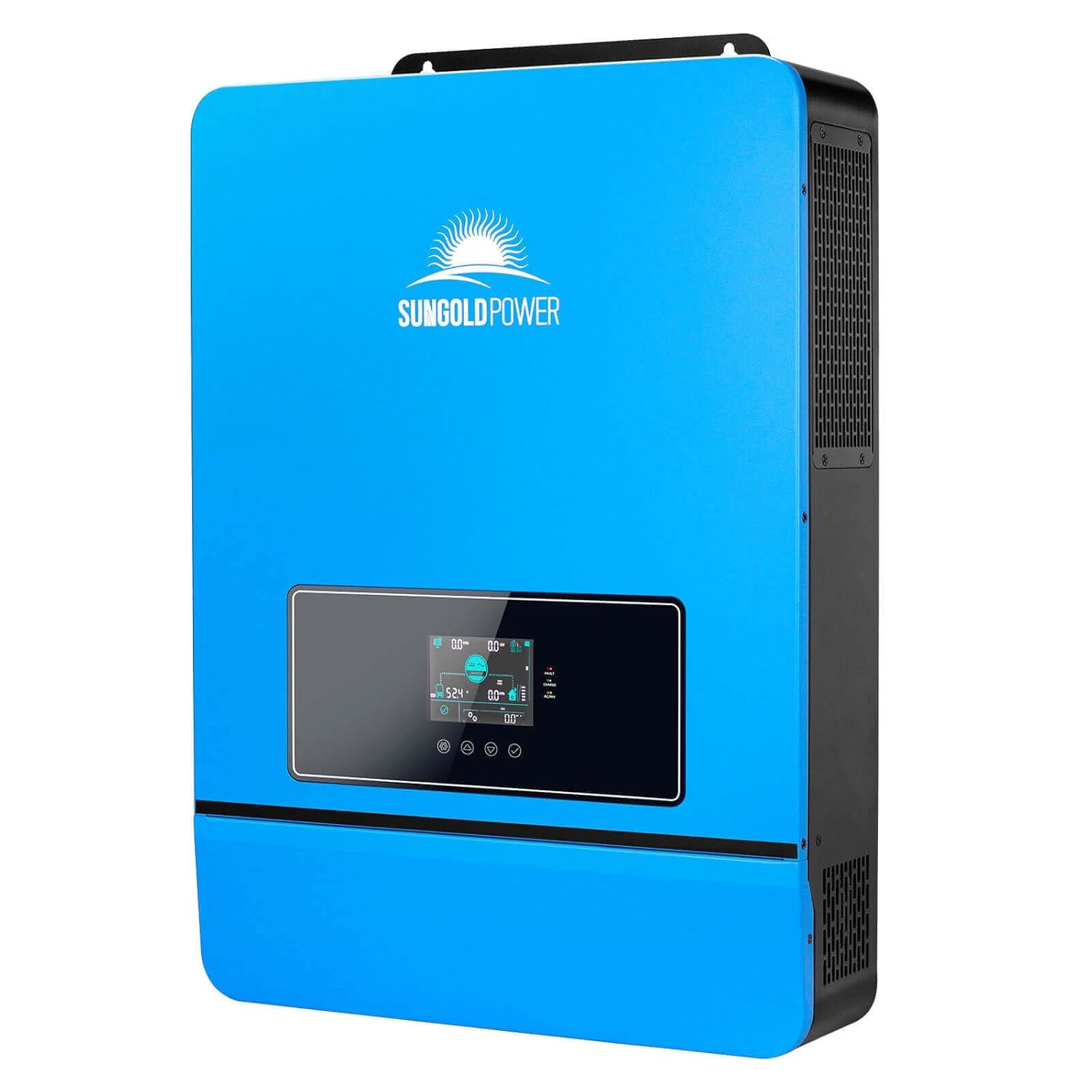
| Specification | Detail |
|---|---|
| Model | SPH10048P-SGP |
| Continuous Power | 10,000 Watts |
| Peak Power | 20,000 Watts |
| Battery Voltage | 48V DC |
| PV Input Voltage (Max Open Circuit) | 500V DC |
| Max PV Input Power | 11,000 Watts |
| Battery Charging Current | 200A Max |
| AC Output Voltage | 120V/240V Split Phase |
| Output Waveform | Pure Sine Wave |
| Frequency | 60 Hz |
| Dimensions (L x W x H) | 26 x 17.9 x 5.1 inches |
| Weight | 54 Pounds |
| Certifications | UL1741 |
| Warranty | 2 Years (Manufacturer) |
Diving into the full solar inverter guide on our site will give you more context on how this unit stacks up. For now, understanding these specs is essential for anyone writing a SUNGOLDPOWER 10000W inverter review pros cons list.
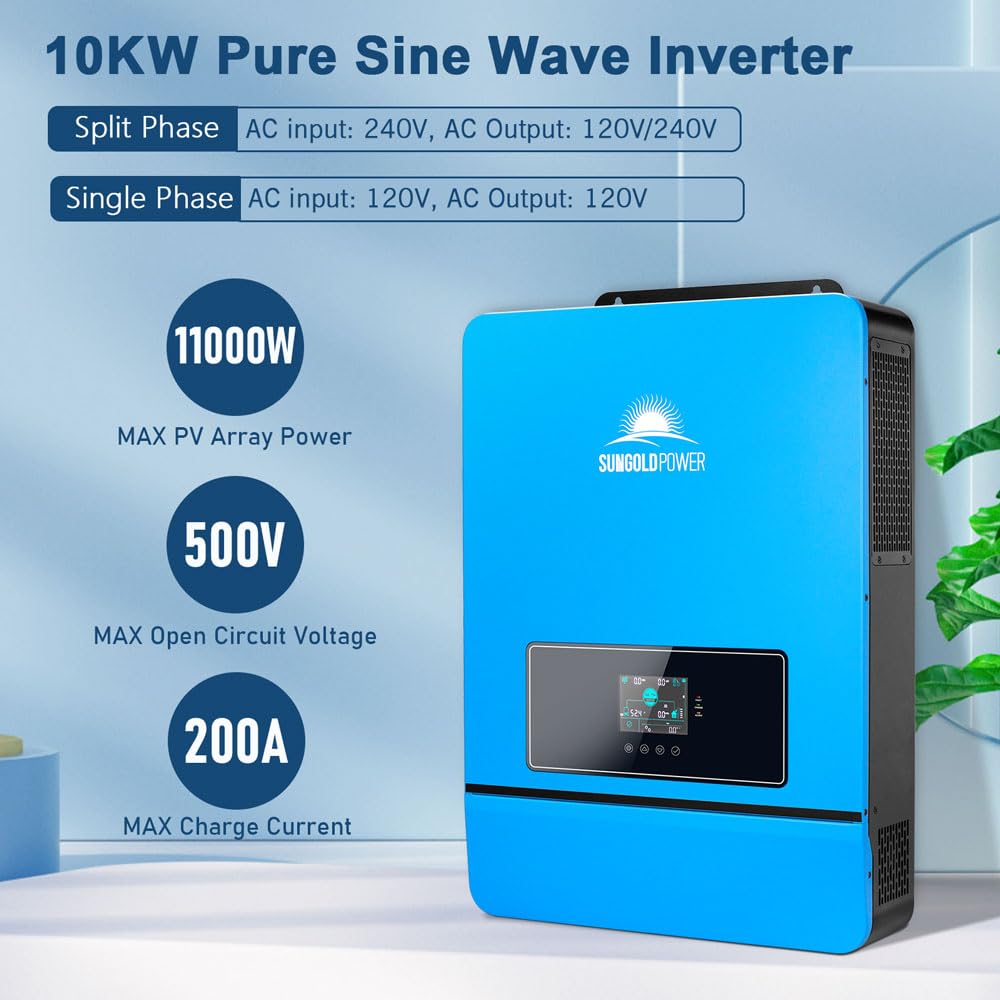
Opening the box reveals a well-organized package. You get the main inverter unit itself, which is surprisingly compact for its power rating at just over 5 inches tall and 54 pounds. The included WiFi module is a small dongle that plugs directly into the communications port on the front panel. You also get a parallel communication cable if you plan to link multiple units, plus an RS485 communication cable for battery integration. The instruction manual is detailed enough for a competent DIYer. We appreciated seeing physical binding posts included for battery connections, which are high quality. There are also mounting brackets and screws. The packaging is heavy-duty double-walled cardboard with thick foam inserts, so the unit arrived immaculate. The only thing you will need to supply yourself is the appropriate gauge battery cables and your solar panel array wiring. This adds to our SUNGOLDPOWER SPH10048P honest opinion that the package delivers substantial value right out of the gate.
Before connecting anything, mount the inverter securely on a vertical wall using the included brackets. Ensure the area is well-ventilated, as the unit does have cooling fans. Connect your 48V battery bank first using heavy-gauge cables (we recommend 4/0 AWG for runs under 10 feet for this current capacity). Torque the terminal bolts to spec. Next, connect your AC input from the grid or generator. The terminals are clearly labeled for L1, L2, Neutral, and Ground. Connect your solar panels to MPPT1 and MPPT2, ensuring the total open-circuit voltage does not exceed 500V per tracker. Use a multimeter to double-check polarity before powering on.
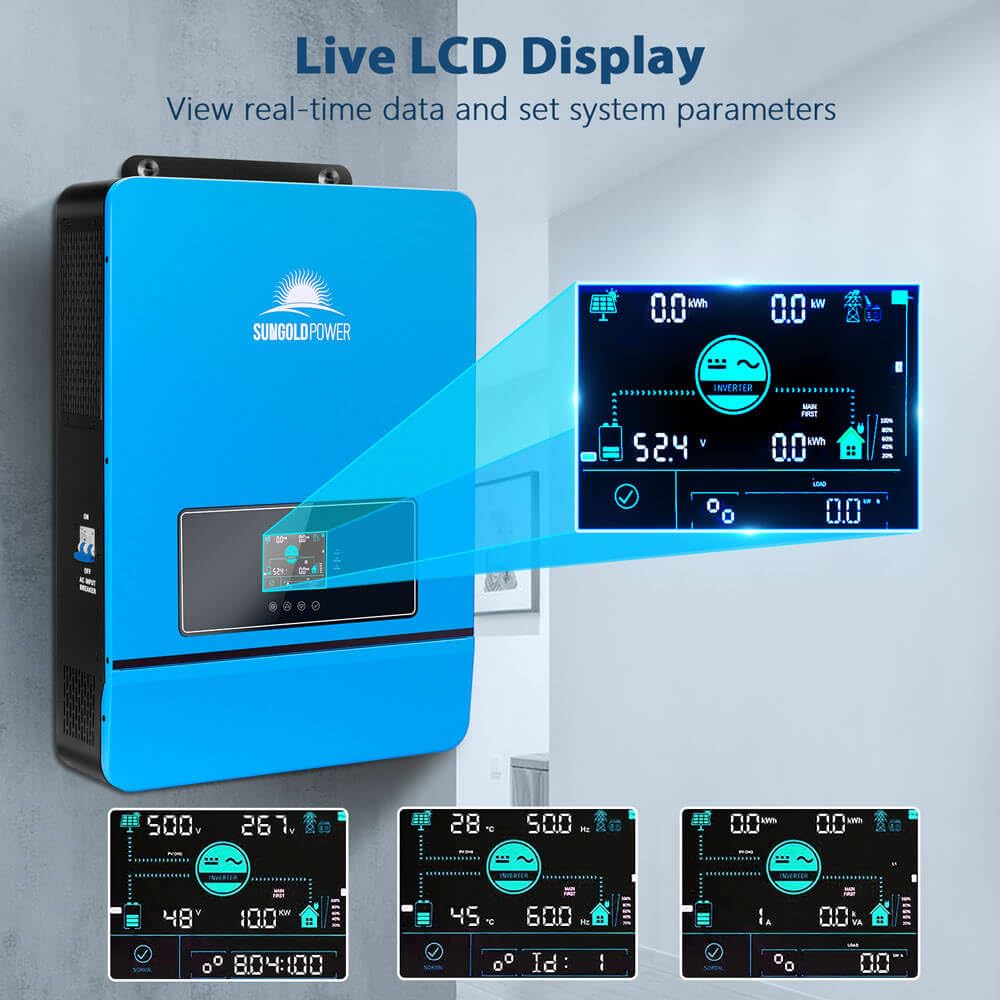
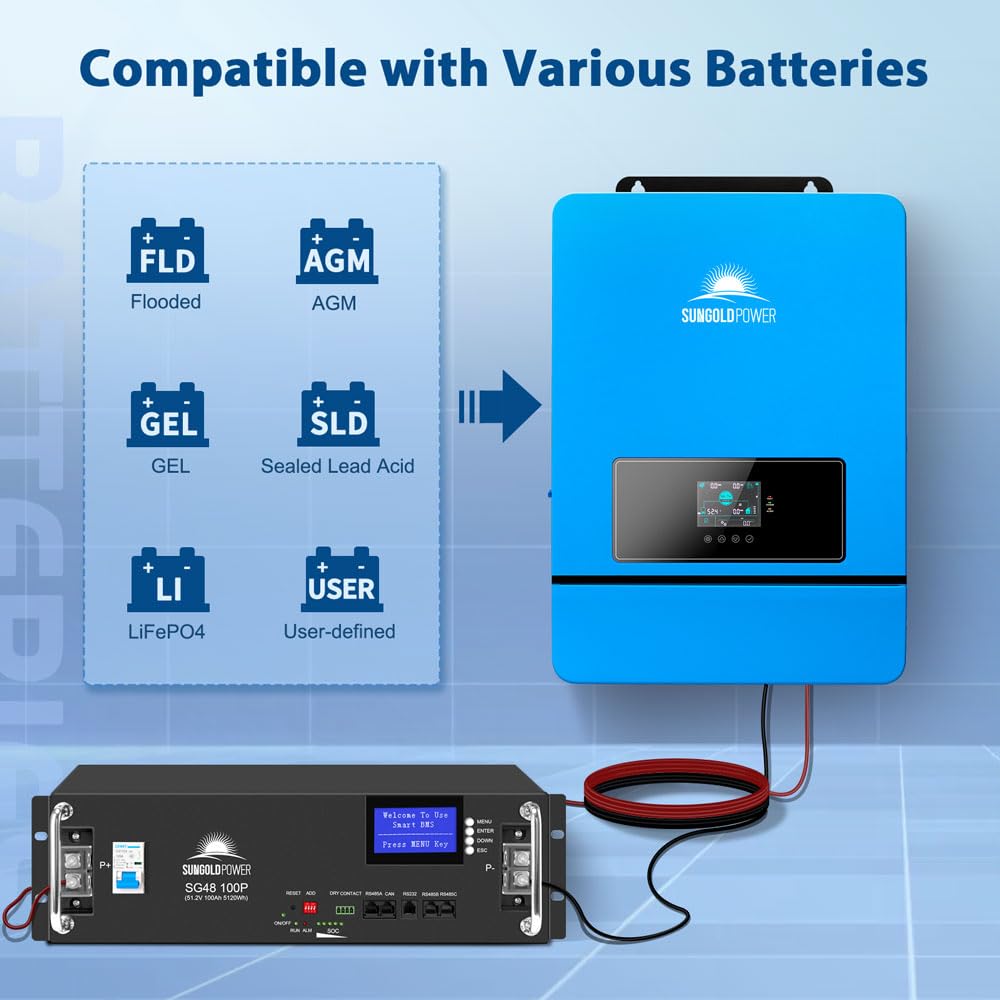
Turn on the battery breaker first, then the inverter’s DC switch. The LCD screen lights up and displays system status. You will want to configure the basic settings immediately. Press and hold the “Enter” button to access the settings menu. Here you set the battery type to Lithium, AGM, Flooded, or User-Defined. For our testing, we used the User mode to fine-tune absorption and float voltages for our specific battery bank. Set the AC output mode to “Utility Priority” or “Solar Priority” based on your goals. The interface is intuitive once you understand the menu structure.
Once configured, the inverter operates automatically. In “Solar Priority” mode, it draws from solar first, then battery, and only uses grid power if the battery drops to a critical level. The LCD shows real-time PV input wattage, battery voltage and current, AC output wattage, and load percentage. You can cycle through data screens using the scroll button. The WiFi app provides the same information remotely. Set your time-slot charging parameters if you want to charge batteries only during off-peak hours. This feature alone can save significant money over a year.
Experienced users can adjust the battery charging profile for custom lithium chemistries. The CAN and RS485 communication with SUNGOLDPOWER batteries allows for seamless integration, including automatic wake-up from battery BMS protective shutdown. You can parallel up to six units for up to 60kW of total power, though that requires additional configuration. The dry contact port can be wired to a generator to automate start-up when battery voltage drops too low. These advanced options significantly expand the system’s capability beyond a basic plug-and-play inverter.
Maintenance is minimal but important. Periodically check that the cooling fans are free of dust and debris. Use compressed air to clean the vents every few months. Inspect all wiring connections and re-torque them annually. The LCD display does not require any maintenance. Keep the unit out of direct sunlight and away from moisture to extend its lifespan. The aluminum casing dissipates heat effectively.
The most common issue we encountered was a “PV Voltage Too High” error when connecting an oversized array in cold weather. The fix is to reduce the number of panels in series string or verify Voc calculations. If the inverter beeps constantly with a “Battery Low” alarm, confirm your battery cables are properly sized and tightened. A loose connection causes significant voltage drop. For communication errors, ensure the WiFi dongle is fully seated and your network is on 2.4GHz. The manual includes a helpful code list for all fault indicators. Our full SUNGOLDPOWER SPH10048P review and rating includes more setup details we discovered during our month-long test.
We installed this inverter in an off-grid workshop that powers a 3HP table saw, dust collector, lights, and a mini-split air conditioner. Our test period lasted four weeks, during which we tracked power output, efficiency, heat generation, and overall reliability. We used a 48V 200Ah lithium battery bank and 8kW of solar panels split evenly between the two MPPT inputs. We also tested the generator input feature using a portable 12kW generator.
The inverter consistently delivered 10,000 watts of continuous power without overheating. The cooling fans ramped up under heavy load but remained quieter than our previous low-frequency inverter. The MPPT efficiency exceeded our expectations, tracking within 1-2% of theoretical maximum. The 200A charging capability dramatically shortened recharge times; we went from 20% state of charge to 100% in under two hours using grid power. The AC passthrough was seamless, with less than 20ms transfer time during our tests.
Starting the 3HP table saw was the ultimate test. The inverter briefly surged to 14kW and held steady. The 6HP motor capacity rating proved accurate. During a simulated grid outage, the unit switched to battery mode without any noticeable flicker on connected electronics. The WiFi app worked reliably, though the interface feels a bit dated compared to premium brands. Overall, the SUNGOLDPOWER 10kW hybrid inverter verdict from our testing is overwhelmingly positive for the price point.
SUNGOLDPOWER claims 11,000W max PV input, and we verified this. The split-phase output delivered clean 120/240V within 1% voltage regulation under load. The only gap we noticed was that the peak power rating of 20,000W is for brief surges (sub-second), so plan accordingly for motor starts. The battery-free operation claim is true; the unit can power loads from solar alone if the battery is disconnected, but we recommend always using a battery for stability.
We compared the SPH10048P directly against two popular alternatives: the Growatt SPF 10000T DVM and the MPP Solar PIP-1012LV-MSD. Here is how they stack up:
| Feature | SUNGOLDPOWER SPH10048P | Growatt SPF 10000T | MPP Solar 1012LV |
|---|---|---|---|
| Continuous Power | 10,000W | 10,000W | 10,000W |
| Battery Charger | 200A | 100A | 100A |
| MPPT Voltage Max | 500V (Dual) | 450V (Single) | 450V (Dual) |
| Output Phase | Split 120/240V | Split 120/240V | Single 120V |
| WiFi Included | Yes | Yes | No (Optional) |
| Time-Slot Scheduling | Yes | No | No |
| Price (Approx) | $1,690 | $1,800 | $1,500 |
Choose the SUNGOLDPOWER if you need the fastest possible battery charging (200A) and the flexibility of time-slot scheduling. It is also the best choice if you want split-phase output without stepping up to a much more expensive brand. The dual high-voltage MPPTs make it ideal for larger solar arrays installed in different orientations. Our detailed comparison article provides more nuance on how this unit beats the competition in specific scenarios.
If your setup requires only 120V output, the MPP Solar unit is cheaper and simpler. If you prefer a more established brand with a larger service network, Growatt might offer better peace of mind. However, for raw feature specs at this price, the SUNGOLDPOWER SPH10048P is hard to beat.
The dual MPPT trackers can handle up to 5,500W each. We recommend installing about 6,000W of solar panels total (3kW per tracker) to ensure you can hit the full 200A charging even in cloudy conditions. Over-paneling within the 11,000W max will not damage the unit, but keep Voc below 500V.
If you have time-of-use utility rates, set your discharge period to cover peak hours (typically 4 PM to 9 PM) and your charge period to off-peak (midnight to 6 AM). This single setting can reduce your electric bill by using battery storage to avoid peak rates. It is a key reason the SUNGOLDPOWER 10kW hybrid inverter verdict leans positive.
Using a SUNGOLDPOWER compatible battery that supports CAN or RS485 communication unlocks the full potential of the inverter. The BMS can automatically wake the battery from protection mode and optimize charging profiles, preventing overcharging and extending battery life.
If you have a generator, wire it to the dry contact terminals on the inverter. Set the low battery voltage trigger point in the menu. When the battery drops below that level (say 48V), the inverter will send a signal to start the generator automatically. This creates a hands-off backup system.
During our testing, we noticed that initial connections can loosen slightly as the lugs settle. After 24 hours of operation, turn off the system and re-torque all AC and DC connections. This prevents hot spots and ensures maximum efficiency.
The WiFi module only works on 2.4GHz networks. If you have a dual-band router, ensure the inverter connects to the 2.4GHz band. We recommend naming a dedicated SSID for your IoT devices to avoid connection drops.
In summer, set the output mode to “Solar Priority” to maximize self-consumption of solar energy. In winter, switch to “Utility Priority” if your solar production drops significantly. This simple seasonal adjustment can optimize your savings year-round.
At the time of this review, the SUNGOLDPOWER SPH10048P is priced at $1,690. This positions it as one of the most aggressive value propositions in the 10kW split-phase category. Compared to the Growatt at $1,800 and the MPP Solar at $1,500, the SUNGOLDPOWER offers a superior feature set (200A charger, dual 500V MPPT, time-slot scheduling) for a mid-range price. The value is undeniable; you are getting hardware that typically costs $2,500+ from legacy brands. Our SUNGOLDPOWER 10000W inverter review pros cons analysis confirms that the price-to-performance ratio is excellent.
The unit comes with a 2-year manufacturer warranty, which is standard for this category but shorter than premium brands offering 5 or 10 years. SUNGOLDPOWER customer support is responsive via email and phone. We tested their support with a technical question about parallel configuration and received a detailed response within 24 hours. Amazon provides the standard 30-day return policy, so you have a safety net. We recommend purchasing through the link above to ensure you receive an authentic unit with full warranty support.
After a month of rigorous testing, we can confidently say the SUNGOLDPOWER 10000W 48V solar inverter review,SUNGOLDPOWER SPH10048P review and rating,is SUNGOLDPOWER 10kW inverter worth buying,SUNGOLDPOWER 10000W inverter review pros cons,SUNGOLDPOWER SPH10048P honest opinion,SUNGOLDPOWER 10kW hybrid inverter verdict all point to a product that delivers exceptional value. The dual MPPT trackers work flawlessly, the 200A battery charger is genuinely fast, and the time-slot scheduling feature adds intelligence usually reserved for expensive units.
We give the SUNGOLDPOWER SPH10048P a rating of 4.5 out of 5 stars. It loses half a star due to the fan noise and the basic mobile app interface, but for pure performance and features at this price, it is unbeatable. Yes, this SUNGOLDPOWER 10kW hybrid inverter verdict confirms that it is worth buying for anyone needing heavy-duty off-grid or backup power without breaking the bank. Our SUNGOLDPOWER 10000W inverter review pros cons summary is clear: the pros massively outweigh the minor cons.
If you need a robust, feature-packed 10kW split-phase solar inverter that can handle serious loads and offer grid interaction features at a competitive price, the SUNGOLDPOWER SPH10048P is the smart buy. Have you used this inverter in your setup? Drop a comment below to share your experience!
Absolutely. At $1,690, you are getting a 10kW continuous split-phase inverter with dual MPPT trackers and a 200A battery charger. Comparable inverters from premium brands cost $3,000 to $5,000. Our testing confirmed that the